
Before You Cancel That Software
Coming Tuesday, November 24 · 34 min · Guillermo Rodriguez and Joe Soliz · Read the transcript
Have you looked at your software bill lately and thought AI could do half of this? Before you cancel anything, Guillermo and Joe talk through what to ask first, and what the replacement will really cost to own.
About this episode
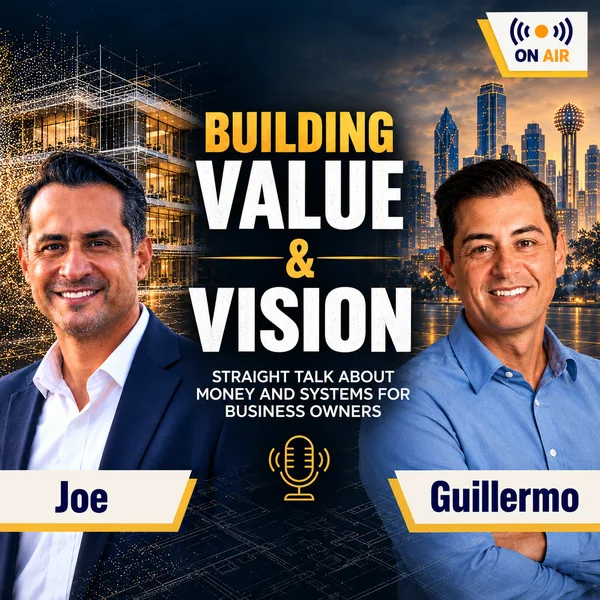
Should you cancel your software and build your own with AI? Guillermo sits down with Joe Soliz, a business and technology advisor to architecture, engineering, construction, and building operations firms, to talk it through.
Joe explains why the CRM is the first tool everyone wants to rebuild, and why that isn't new. He shares his car analogy. You buy a car, you don't become a mechanic, but you're responsible when the tire blows out. He walks through two kinds of diligence. First ask whether this is your lane. Then write down exactly what the tool has to do. He also names the costs below the waterline, like support, training, documentation, and who maintains it if the person who built it leaves.
Guillermo shares why he replaced his own budgeting software, why it still feels good to have a vendor to call, and the two questions he asks before canceling anything. Does it help increase sales? Does it help reduce cost?
Your takeaway is one idea. Before you cancel, know what the tool costs you today and what the replacement will really cost to own.
In this episode
- What makes an owner call a technology advisor
- Year-end cost cuts and why owners are canceling software
- Why the CRM is the first tool everyone rebuilds
- You buy a car, you don't become a mechanic
- Two kinds of diligence, is this our lane and what exactly does the tool need to do
- The costs below the waterline
- The comfort of having a vendor to call
- The two-question test for any software decision
- What AI still can't see for you
- Low stakes and high stakes decisions
About the hosts
Guillermo Rodriguez is a CPA and co-founder and CEO of High Point Finance Leadership, where he helps construction and real estate business owners turn their numbers into confident, well-aimed decisions.
Joe Soliz is a business and technology advisor and the founder of Digital Conditions, where he helps AECO firms turn messy technology, data, and operations into decisions that move the business forward. digitalconditions.com
Read the full transcriptAbout 34 minutes · lightly edited for reading
Quick question for everybody listening. Have you looked at your software bill lately and thought, "AI could probably do half of this"?
Maybe you already canceled a few subscriptions and it feels really good, right? You're saving a bunch of cost.
But who's maintaining it? And who's maintaining what is gonna replace it? And where exactly is your data living?
If that one made you pause, you're in the right place. This is Building Value and Vision.
I'm Joe Soliz with Digital Conditions. I live on the technology side.
And I'm Guillermo Rodriguez, High Point Finance Leadership. I live on the money side.
Same clients, same headaches, two different desks.
Just two guys who've sat across the table from owners just like you.
Grab your coffee.
Let's get into it.
Welcome to episode number two. So,.
If you run an architecture, engineering, or construction firm, there's probably not a tech person sitting in your leadership meeting. So every technology decision that you have to make, it lands back on you. Which software to buy, how to structure your technology, which ones to cancel, where your files are being backed up, whether it's safe to put a client's data into AI, you know, cybersecurity.
And when you guess wrong, you have costly mistakes, you know, once for the tool and again for the mess that it could leave behind. joe has spent over 25 years in that world. Firms call him to find out what's really broken, to build a plan in the right order, and to stay accountable until that plan works.
So think of him as, a business and technology advisor for your business. And, we're gonna get into that today.
So let's just say I go to Joe's website right now, and I'm gonna schedule a call with you. when a business owner calls you, what triggers them to schedule some time with you and to have a conversation?
Yeah. So it could be a variety of things. It's a good question because, as you and most folks in the modern day realize, technology is super broad, right? used to be the term IT was, monitors and computers underneath your desk and now, the idea of your data living on a cloud and living on data center, using phones and apps and now using AI, it's all distributed, and there's multiple layers and, all kinds of different technology to achieve certain ends.
And sometimes these technologies are so layered that it presents new problems that then further technology solves, right? When an owner calls, me, that can be an architect, it can be an engineer, folks that are building design professionals, or building operators. Those are primarily the two.
And in the middle is that construction space, which I help out quite a bit with. But primarily, I help folks on the architecture, engineering, design side and the operation space. And at the end of the day, it all comes down to what happens with the data from the time that it's a concept to the time that it lives over in the operation stage. and so the conversation is really how do we optimize individual processes within our singular business as an architecture firm, engineering firm, or in operations or in construction, all the way to the higher level, which is how do I get the data that's relevant How do I get that to persist through so that it serves the end product? Because at the moment, our AEC industry has been for a long time fragmented in a way that start, stops. so I've been in the space of ensuring that information can have some continuity between stakeholders, where it makes sense, that's the key because a lot of the software vendors and, solution proselytizers tell you that it's this long continuous stream, and that if you get it right, that it's gonna be great for everybody. And the reality is that not all solutions have, everything you need. So that's one reason why architects, AEC folks call me, is what's happening with the data. Now let's talk about the fundamental layer, which is sometimes I'm being called for ideas like we're spending way too much on our, IT management system. We got hacked. They didn't have a plan, or they had a plan and it didn't execute on their SLA, their service level of agreement, that it cost them a lot of time. They can have a two hundred man firm who are down for four, eight, twelve hours.
That's costly, man. That is so costly on many levels, not just on not being able to do the work, but, the opportunity cost, the downtime, and then how do you get that data back. So a lot of times folks get fed up with the total cost of ownership for their infrastructure, and so that's where I come in and say, Let's look at these data management solutions. Let's look at the infrastructure that you currently have, file servers sitting here. What should be put on the cloud, and how should they be connected given your workflow?" so at the end of the day, it's about strategizing a total system. And so of times I'll get calls from owners and CTOs and CIOs, those who are building the infrastructure to get their work done. they realize that there might be an optimization layer. And that's actually, I think, part of, a huge part of what's happening today, but from a different side, from an AI side. From the AI side, it's like it can do so much for us, and I hear that I can code, maybe I can just build stuff.
And they're, they're not-- That's not, that's not inaccurate, but it comes with a huge amount of caveats. So to say what do owners call me for, it's multi-layered. It could be on the production level, it can be the infrastructure layer, and it can be on the futuristic layer, which is to say how do we make our technology, specifically AI is the large at subject today with AEC. I use this technology in a way that meets our objectives for the next two to five years?
So that, that's a good segue right into like what, what we wanna talk about and what our episode is about today. Like we ha- what's happening right now, I know just personal experience working with clients, it's end of year, naturally that's when we're m- highly motivated to make cost reductions,.
So we're looking at everything, every vendor, assessing everything, and software cost, what I saw happen across the board, software costs went up. There was more investment in AI and consultants. and then at the same time, like now what's happening at the end of the year is, we learned a lot through that and said like, "There's a lot of stuff we could do on our own."
Like an example I always use is my budgeting software. I used to pay for that. it did have some limitations, and I started building it out in Claude and it's way more clear, way better and saved a few hundred bucks a month, you know. So I canceled that right away. and there's some software that's just so simple that it makes sense to cancel it and to build it out on your own, do something different.
I wonder if there's risks to that. owners are canceling software left and right. The big one would be like CRM systems, right? Managing your leads and all that. I'm like, man, that's scary. but there is a lot of people just taking that dive right now and they're like, "We're building our CRM."
There is.
It could be a smart move. It's costly, right? But, it could be an expensive, mistake, right? Or,.
Yeah, I'd love to touch on that a bit. I'm gonna highlight, emphasize the word could. It.
Absolutely. It absolutely could be. So I'll do a callback. If, any of our listeners remember, Microsoft Access.
Oh yeah.
Access, if you did any training on Microsoft Access, one of the first things they teach you is how to catalog things. That's how you learn how to use Access, and at that time it was, like, cataloging books, CDs, contacts.
And almost everybody who had a business in the '90s, their CRM was some form of homegrown Access database.
Yeah. Mm-hmm.
And it got sophisticated and that turned into SQL and then people started making SaaS products, software as a service, so earlier I made the suggestion that technology introduce new challenges that would then be solved by technology. So as an example, the '90s you would say, "Well, the CRM, you know, we'll just, do a bulk email through Outlook." But when the CRM moved to, a SaaS model, the software as a service model online, now it's like, well, how can I further automate that, what I was doing a bulk upload with this manual... The wheel is getting smoother. it was, it had sides to it, and now we're smoothing out the sides, and now we have to add more technology to it, okay? That concept of the wheels getting smoother over time with new layers of technology, that idea will not go away. So hold onto that principle, right? Because what'll happen for folks who are not experienced with software development, like, personally, I've developed, and when I say I develop, I've had teams. I'm not a coder. Never have been. I tried a few times. but I have a coding team. I've had coding teams. I've had really smart fellows on my team, and I've learned so many different lessons.
I mean, the simple ones are things like, you know, when you're solving a problem, what exact problem are you trying to solve? Are you considering all the basic functions that need to be done for that thing? a lot of times when folks have a hammer, right, what's the old saying? Everything looks like a nail, right? Or if you have a shovel, guess what? If you swing that shovel, it could be a hammer. And sometimes folks don't understand they need the shovel or they need the hammer. so teams that are, companies that are moving into developing the software, you can walk into a wall. You can make, and not know it.
That's the problem that I'm kinda to. now bring back that principle that I mentioned a minute ago where things get smoother. If there's no future looking on how things would get not only do you walk into a wall, use the wrong function tool, now set the foundation layer in a way that.
You're unable to smooth out the wheel. You have to back up and move back into another direction, okay? So let me now move from that onto some positivity of it. think that folks, companies that are smart to some of the things that I'm bringing up, and there's so many other nuances that I'm not mentioning right now about proper software development, But I think there's some- firms out there who get it, who have done it.
I have one of my clients who've been with me for almost 10 years now. they've grown from 400 people to 1,400 people in the last 10 years. Tremendous growth in the last five years. They've had coders on their staff for decades, right? So They have the guys who know what I'm talking about. So guess what? Not only are they AI-enabled, but they have resources that actually know how to build stuff they actually have experience in building products and to keep in supporting them. it's teams like a contractor firm that I met, the other day and, we were discussing a meeting that the person had just exited out of previously about AI and, had a whole roadmap to, "We're gonna knock out this software and that software and this software," and the first one was CRM.
And it goes right back to the point that I was making about access. Why, why is that the first rung that everybody's chasing to? Why? Because it's the easiest, right? It's how you train on it. It's how, it... And, and look, there's nothing wrong. If your use cases are really s- simple, cut and dry, and, and, and walled off and you f- did the functional specifications of what exactly you need to, accomplish, and you involve the right d- software developers, whether externally, like with my team, or internally with somebody that has, has deep experience, you will avoid those problems and make a great solution for yourself. But you gotta think about the support that it's gonna need over time. Where, what happens when things need to be smoothed out? can somebody pick up the ball, w- if they were to leave, the people that are building it? and, and look, I think that maybe there's a time where it's 100% all AI, and you never have to touch the code. I mean, we're close, it feels like. But the reality is, is that, you can ne- you s- just like every professional, to keep the decision-making and judgment in the, in, in their process of utilizing or having AI complement their work,.
.
Is true, for software development. because it's not just I created this thing and it works. happens when you need a new feature? What happens when, you know, Jim's stuff doesn't work?
To add something to it, like where, where's the access control? Where's the support mechanism? Where's the growth plan for it? You've now effectively have become a software development company. And I tell folks this all the time. When you a- adopt something, let's say like, okay, I give you a good really, a, a but I think a pretty fair analogy. you buy a car, you don't become a mechanic But you're responsible to be the mechanic. If your tire blows out, who's gonna fix it?
You better know how to change a tire or wave somebody.
How to.
Yeah, I'm glad you made the analogy 'cause, like, I'm thinking of my own way to understand it, and I'm sure the listeners are too. the one thing that sticks out to me or, how I relate to it is, it's just like your health, right? Like, you go to the doctor, but you're really the only one that knows exactly what's going on and what you need.
And that's what, Claude has really done for me, and I see it in my clients. Like, they know exactly what they need. No one knows your business better, the ins and outs, where your strengths are, and, you know, you're spending all weekend up all night, figuring things out. And what I've seen is most people fall into either, not empowered enough, you know, they're.
You could get in there and start learning a lot and do so much, with the skills that you do have. And the other extreme, I think, is what you're describing is when you need a software developer, like how to know when to get there. What, you know, given that, where do you think would... What's a real practical kinda way to look at that and say, "I'm trying to build my.
I, I think I can build my own CRM. I know what, what my strengths are. I know what I'm not getting from my current setup." how do you not go too far into that where it's a bad decision or, or it's a waste of time? 'Cause that's the other thing that happens with development, on your own and trying to code and build things is that you waste a lot of time.
That's right, yeah.
So where's that, happy medium where it's like, yeah, spend a bunch of time trying to learn on your own, code on your own, build out what you want it to look like, but not so much to where you actually break things or don't design them correctly or build them in a way that you can't come back and fix them the way that it needs to be fixed?
Is there, some practical things that, business owners can think about before they start moving too fast, if moving too fast is even a thing?
Yeah, I think so. I think that, having a comprehensive look at the problem, really understanding the problem and not at the surface level. And when I say to understand the problem, I'm not saying just to execute, but understand the problem enough to know if this is, worth investing in. If you say, yes to one thing, you're saying no to a bunch of other things, right? So executives and business owners would learn really fast that you have to be good at saying no where it matters so that you can say yes somewhere else. so if you are gonna AI replacing some software, it's critical that you understand the problem so well that you realize that it fits business, goals and fits your business in general.
Because what folks don't realize, going back to the car, that when you buy that car, you've assumed the responsibility of the mechanic Even if you outsource it or even if you do it yourself, you now have a car, and whether you like it or not, it's gonna require some mechanical doing, whether braking, maintenance, whatever, or adding on. So my point is, is that there's two types of diligence that need to be created. One on the investment of diligence. Is this our lane? Or do we partner and it becomes our lane? Do we do it internally and it's our lane? Do we partner and it is our lane? Or do we completely outsource and it's our lane? do we not outsource and we just rent software as a service? Folks are forgetting that that option is still very.
Just because you can doesn't mean you should. of all the software functions that you have, I remember hearing something similar to this is, it was some cloud service that came out by a major, software company in our world, and somebody says, "Oh yeah, we're gonna move all of our data off to the cloud." funny enough, this guy was So technical, he was super excited, and he saw the vision in it and didn't realize that those features were not even, available. He was just so excited to move to the cloud that he was already preparing to do it. I know it sounds, pretty bizarre, but I come to find out that the way he understood the product wasn't it.
I guess I don't wanna digress or trail off too much, but is that technology can be exciting. Folks get ahead of themselves. They get over their skis, and it has to be tempered with, is this our lane? Now, granted, quote unquote, our lane is changing in architecture and in every industry lanes are changing.
We're assuming different responsibilities. So what needs to be done is to what degree is this problem going to be our lane now? That's the first rule. From there, once it passes the criteria, then the due diligence begins. What are all the functional specifications, right? It really has to pass the investment strategy first And our capabilities and who we wanna become as a company. Then it goes into the due diligence of, what are all the features that we require? How hard is it gonna be to... Basically, a functional specification.
Called in software development, how exactly does it work? And then, the ontology of, you know, basically all the technical bits that say how things are gonna work together. And that's where you then would, get us guys, like on my team, to say, " We'll do a AI readiness assessment." Basically, where's all your data? And is it structured or standardized? how does that readiness assessment go against this use case that you're wanting to do? You match that up and see where the gaps are. 'cause those gaps are gonna be where it's gonna cost you more money. you narrow the gaps, and then you come up with a plan. Now then you have monies, you have a financial plan to go back to the beginning of the investment, outlook to say, now is dollars and cents, does it make sense? So I think that, I guess to answer your question, maybe more concisely, is the diligence really needs to be done on two different levels. Is this who we are, and is this what we wanna become? and then because there's, I mean, how many pieces of software do we all use on a daily basis, right? How many of those do you wanna into? Which one's gonna have the biggest impact? so.
Can you give some examples of like how I would ask myself that? And are you talking more about is this who we are in terms of we're a software developing company? Or, what are some outcomes of like, when you're dealing with that decision and you answer that question?
Like, is, this who we are? can you kinda dig into that a little bit more?
I mean, I guess we're getting a little-- That, that's a little bit of a business philosophy kind of a thing. because I think most, folks in business who are leading, who charge-- the charge of a company, have seen the importance of vision casting and what it does and what it doesn't do when you're not regular on your.
It's such an underappreciated part of business philosophy that I think folks a lot of times get stuck. I have. And you have to recast your vision. So when I say more about who we are, again, trying to get the most out of this analogy of the car. when you buy a car, you know, it gives you a new ability, right? You're able to go places. You're able to meet some-- You're able to help people. You're able to... Right? So why are you buying the car, right? It's not that you're trying to augment your identity, it's that you're augmenting your abilities. But by augmenting your abilities, you are, not even inviting your owning responsibilities that must exist in order for it to be successful. So not to say you buy the car then you're gonna be a mechanic, but you have to have some level of understanding and knowing your resources, right? So back to, like, who we are. Yeah, if you decide to build any kind of solution with AI that fits into your business, you are assuming the responsibility of maintenance, support, feature enhancement. and if it stays static for a long time, that's fine. but what happens to the team that executes upon that as attrition occurs in business, right? Is there a singular owner there who owns that piece? We're so used to buying software, plugging it in, calling somebody for help are we, budgeting for that tax that we're now inheriting?
It's, yeah,.
So sometimes that's not always seen. What about training, right? think of the iceberg, right? There's this much of the solution above the water. Wow, look at all this great stuff Here are all the costs. And then you go below the water and you're looking at the support, the training, the documentation writing, you know,.
Yeah. I think that the one thing Claude hasn't done very well for me is tracked how much time I've wasted with them, right? It's like I've tried to build a lot of things, and I'm excited about what has been built, but hopefully over time that time waste or the things that you build. And I think that's more of the goal, is not only getting to the solutions, but getting to them and like kind of some of the things you said is, understanding the cost, understanding the future, putting dollars to all that, and saying like, "Is this solving, like, who we are?
Is it solving our problem? and does, does it fit into, into who I am?" Like you gave the car analogy, and we struggled, our family re- recently to, to buy a new vehicle, right? And we didn't wanna go really big SUV. We were like, done with this. I don't wanna deal with the mechanical problems of a big SUV," actually.
Like exactly what you said. We researched this around, looked at every single vehicle, and then at the end we came back to, " Yeah, this is who we are. We're a big SUV family. We need a...
What we.
We got three, three, three kids, and we need a big SUV that we can, climb into it and almost stand up in there so we could put our kids in the, in the back seat.
And you know what? I am willing to deal with the, the future maintenance problems of having a V8 engine." And but I said, "Okay, how do we solve for it?" And we said, "Okay, we are definitely going to have this car under warranty, and we are selling this sucker before it gets to that, f- 50,000 mile or, or whatever it is," 'cause we've already dealt with mechanical issues.
And so it, it felt like who we are. And, and.
I- it's imposed upon you,.
What I mean by that is, like,.
Back, I got in the architecture business, when the guys who were drawing on big boards.
So that kind of was put upon the industry. So then now guess what? now you have a CAD team and you have a CAD leader. Now we have AI, fast-forward to today, and now you have an AI team. So our identities internally, we're creating and,.
And as the industry evolves and as solutions evolve, our identities become a little different. we now have layers of an AI team, and so what parts of that do you want to absorb into your business?
Meet your objectives as to what you want your business to be? in your vision casting, does pulling in those opportunities match what you want your company to be in the future? Now, if we're all gonna be big SUV guys, and that's just the nature of what we need to do, how do we structure that?
Do we pull it all internally? Or do we go learn-- Do we get a manual, now we're the mechanics?
Or do we say, my brother Jim, a guy right down the street knows how to do it, or he has a body shop or a shop down the road? There's ways that you can complement that, and it hearkens back to the early, '90s where we would hire software integrators to develop software. That's the way it used to be. We would hire guys around the corner from your office to develop software before it was a software as a service. And so there's this nice little loop that's happening. history repeats itself, as I said, or rhymes. And so I believe what's happening right now is that everybody's experimenting. And they're gonna go through the same things that we're talking about, and they're gonna realize how much time they're utilizing, maybe wasting, maybe.
Look back at all the things I developed.
I've developed a lot of stuff, and a percentage of it was actually commercialized.
And that could be for a variety of reason, not just because it wasn't a valuable product. It could have been that I was chase-- trying to fit a solution in, as is a, a software development 101. think you have solved the problem, but you haven't even checked market demand, right? But, but, or it could be that, you're just not thinking about, you know, the, the critical path of, of development.
And, and you're building out too much, too fast. Thus the idea of a MVP, a most, what was it called? A minimally viable product, right? As a lot of folks have heard.
My version might be a little bit oversimplified 'cause I, I deal with, on the finance side, more, more simplified SaaS, you know, subscriptions, But, I, I'm sensing just from my personal experience, there's, there's, like, two things happening with this.
One, it's that when you are using a, a third party, a SaaS subscription, your payroll provider, other examples that you mentioned, It's like, the full responsibility is not on you, and you, and you kind of feel that. you know, if there's a problem, you have someone to yell at, and psychologically, I think that provides a bit of, like, relief that it's somebody else's.
And what you're describing is that once you commit to this, there is a different higher level of responsibility that you now have as an organization to make this stuff run, to...
Just switch. I guess you could, but you have a higher level of responsibility. And then the other layer is just the simple fear.
Like right now, I didn't have a fear of letting go of my budgeting software. I knew I could handle that. I have a fear of letting go of my payroll software of Gusto. on the personal side, I'm like, "Am I ready to do my own taxes?" No, I'm probably still gonna keep TurboTax. But I think to avoid the psychological part of the decision is I'm looking at two things right now.
I just say, "Does this help me increase sales, and does this help me reduce cost?"
The simple one is just not having the subscription, the cost, and that's not really the big one. to me, it's how that software, that technology helps you track costs, become aware of costs to flag them sooner.
And the budgeting that I did when I got rid of Fathom and built it in Claude is that that solution didn't have, departmental level budgets in a real easy way. It didn't have by-vendor budgets. So now I could assign these budgets to the individual department owners and been like, "This vendor you said was gonna be this much.
This is exactly how much it is." And the prior solution couldn't do that, so there was no accountability over cost. So this just allowed me to drive, much higher level of accountability for, you know, team members that own those individual budgets, and we could see a lot faster.
And so to me, it's like if you're getting over the fear of responsibility or just fear itself is like, let's look at those two things 'cause of course I look at it from the financial side. Does this help me increase sales? Does this help me reduce cost? Overall, that's gonna improve your profit.
I just wanna improve profit. That's what I'm going for.
Yeah, I think that point that you bring up is, certainly I don't wanna be terribly negative on the whole situation because there's huge benefits and you're hitting on one of the major ones is software that can't do exactly what you need it to do. And that's almost, I think in a large part one of the major reasons why you, it's one of the larger ones, is it can do... We can make this thing do exactly what we need and the other one we couldn't. We didn't have a control over it. We could make suggestions, but they wouldn't do it, right? so how much does that give you back? If you spend X time, energy, and effort to get these features, how much is it worth to report on that metrics to your client on the fly? can be tremendous. and not everything is quantitative, right? Sometimes it's a qualitative measure that I can get this out of my High Point CFO guy that I can't get exactly when I need it, right? It's like that, the value just really outweighs potentially. And so that's a really good point that you brought up and, I should have brought it up sooner because that can be a big reason why you decide to own the car. That can be a big reason why you decide to be a mechanic or have a relationship with somebody who knows how to put this stuff together. I think that it's fine to certainly, as a small business owner, which I think is a lot of our target audience at the moment, it's good to do an experiment. larger companies who, you know, a couple million in revenue, 10 million, 15 million in revenue, they still may not be able to afford to have a software developer, you know, whole program in there.
Then you partner with somebody who does understand and can help you vet out where these differences are. So if you replace... the best place to start when you're wanting to replace is just look exactly where the deficiencies are in your current system, right? and, but be methodical about it.
Having those two, areas of evaluation, one is it makes sense long term who we are, what we're doing. Are we willing to be, you know, some level of mechanic, in whatever configuration that is, ourselves, others. and then in the diligence side, figuring out where we can gain advantages, is super, super important.
Yeah. I think every time I have this thought, like, AI can't do that, someone will challenge me, and then eventually it can. but some of this, at least right now, I'm convinced that AI in a way can't help you, see forward. and so that, that's what I heard in there is that, you know, as you're working through these decisions, the one thing it's...
You may not be able to see on your own is the future cost, like someone who is in practice of implementing these decisions, and, and a kind of an finding that in-between solution. You don't have a full developer. You may not be able to af-afford a full development team yet, but working with you to kinda get in the middle of that and say like, where...
What's customized to you in terms of what's the support you need to see the future and what all this, could mean for you? And, and.
Develop just a replacement,.
Then, the cost benefit is exactly what you've been spending, right? It's that reduction in e- expense.
So it needs to be that plus.
And I think that being in practice is still so valuable. Like, I'm not a tax expert, but even though I can research everything in Claude, and I am a CPA, so I have a basic knowledge of taxes, if I'm trying to find a solution for a client in terms of a strategy or, I'm trying to save on cash flow, so the estimated tax payments, all this stuff, I still need to bounce that off a human being who is in the practice of doing taxes and really knows what the real reality is of, decisions that you make.
I think that goes along with what you're saying is to work through this. don't completely, do it alone. It kind of goes back to what our podcast is about and what we touched on in episode one is the value of team, and coming back to your experts, your, people that are in practice of doing this stuff every day to vet out and to at least help and guide you and make some of these decisions without doing it, completely in a vacuum.
Are aware o-of, of the idea. It's just because this is uncharted territory for most businesses, the AI is uncharted for everybody, but the concept is still, something that exists. It- it's, it's a repeat of history, right? on how we approach AI to develop software for us.
It's just another modality of creating software.
And but all those layers still exist. And so I think that those who are in business, they, they... I think our conversation could highlight what they already know, which is you put experts in place. That's why you hire experts to do what they,.
Do what they do. So certainly I wouldn't say for folks to be afraid of doing it, afraid of experimenting,.
Know that when you bring that in, that there are layers to it that you will want to have experts advise you on at minimum.
I mean, I'm advising somebody right now just on a data management solution, and it's, five worksheets in one Excel file of the process of how do you go from knowing nothing to a decision point,.
From the journey of making a decision. and it should be treated as such. It's an important, it can be a very impactful business decision, and it needs to be treated as such.
Yeah. And, and I think we touched on some of these decisions are low stakes, right? You can always go back to your SaaS subscription, and some of these are high stakes. some of the ones that you work on in data management and CRM. Some of these, at the very minimum, you lose a little bit of time or you lose a lot of time, but the,.
What we were trying to avoid is the costly or the losing sales or the increasing your cost and, trickles all the way down to profit, is really losing profit is what we're trying to avoid and hope our conversation touched on today.
Before, you cancel anything, you gotta... From my standpoint is you gotta ask is, is this increasing sales? Is it reducing, cost is it increasing your cost awareness? does it give you more visibility? What does it touch? And, what are the implications?
I think, Joe, you touched on is the biggest one is what's gonna be the development cost, What's the burden? Is the burden, acceptable?
Yeah, I mean, the burden's gonna be there no matter what. and what are our options to the burden? can we do this? And if the answer is yes, and it checks the other boxes that you just mentioned, then it's a viable solution to investigate. But you gotta make sure that you understand what the burden is, and, know that the resources and the configuration by which to support that.
So, Joe, as we wrap up, people are contemplating this decision, where can people find you? what's the best way to get in touch with you?
Digitalconditions.com is our website. You can email, hello@digitalconditions.com. on LinkedIn. just search for Joe Soliz. I'm in the Dallas-Fort Worth area, North Texas, and you will find me.
It's just, it's an exciting time. I mean, we're sitting there trying to make... The average person now is doing coding, and, I think that that's really exciting to just be able to make the solutions on your own, not entirely as we've talked about today, but the possibility of the things we can change.
And I think AI is, it didn't make the decisions easier. we're not having harder decisions, but the getting to the outcome is a lot faster now. So, that's our episode for today. You know, if you're, contemplating, you know, canceling a subscription, know exactly what it's costing you and, and what the new solution is really gonna be really doing for you.
So understand the problem, I think is what we got to today and, send this to someone who's contemplating that decision, who's working through that, which is basically everyone I know right now.
That's our show for today. build the vision and, know the value, and that's what we hope to touch on every episode.
Episode 3 is out December 8.
Your Team Is Already Using AI. Guillermo and Joe sit down with Mark Espinoza to explain what an AI agent really is and the simple habits that keep a small business safe.